
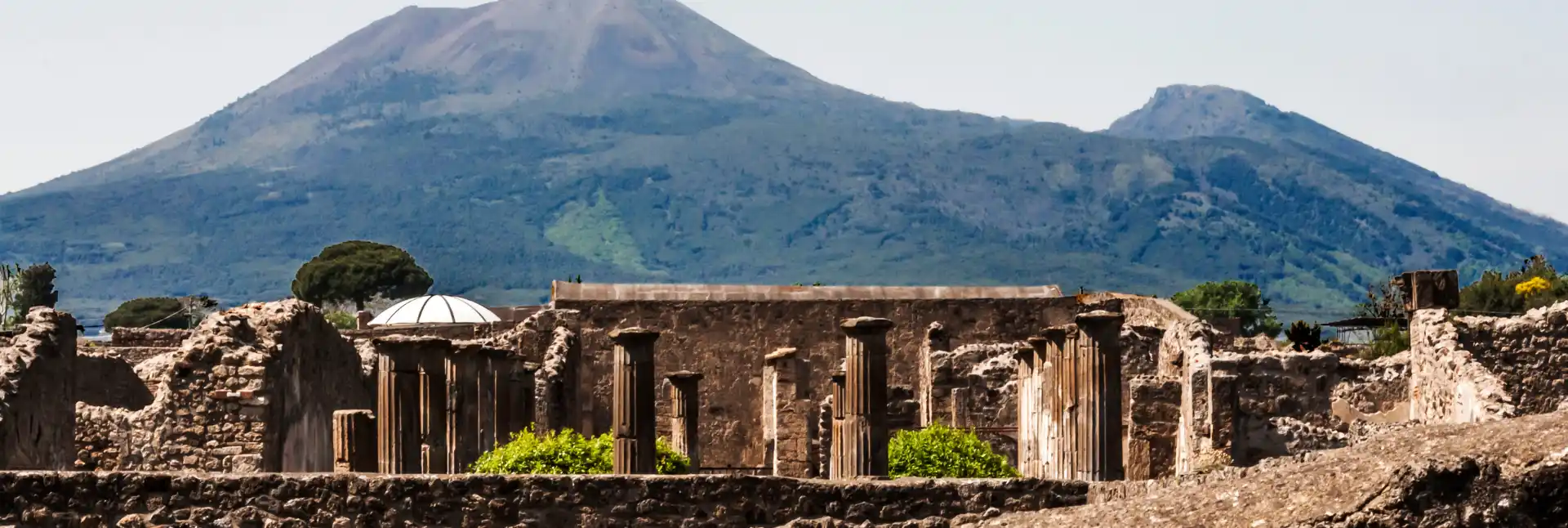
Pompeii and Herculaneum: what really happened during the eruption of Mount Vesuvius
Talking about the history of Pompeii and Herculaneum means entering a territory where tragedy and archaeology come together in a way found nowhere else in the world. These are not simply two cities buried by a volcano; they are a snapshot of two Roman communities with their own rhythms, customs, hierarchies, and landscapes, frozen in time by a natural phenomenon of unprecedented violence.
The Bay of Naples before the disaster
Possibly, there is no other place in the world that takes us back in time quite like Pompeii and Herculaneum. Walking through their streets is a journey that combines the beauty of strolling through an authentic Roman town anchored in the past with the chilling awareness of the tragedy its inhabitants were forced to endure.
To understand the history of Pompeii and Herculaneum, it is useful to imagine the setting first. The Bay of Naples was a mosaic of ports, villas, orchards, and small towns connected by Roman roads and trade routes. Mount Vesuvius, seen from below, was not perceived as a threat: it was part of the landscape, fertile and imposing, yet integrated into everyday life.
The history of Pompeii and Herculaneum
Pompeii, a city of trade and public life
Pompeii was not an isolated corner. It was a lively city, with a forum, temples, baths, taverns, workshops, and a constant flow of goods. Roman urban planning can be read here like an open-air manual: laid-out streets, fountains, civic spaces, theaters… and that deeply human blend of the monumental and the domestic.
Herculaneum, smaller, more refined, and by the sea
Herculaneum was smaller in size but had a different social and urban profile: more residential, with houses displaying a remarkable level of comfort and decoration. Its relationship with the sea was essential: the coastline, harbor warehouses, and the movement of goods shaped its identity. And this closeness to the shore would play a decisive role when the time came to flee…
The day the sky changed color
The eruption that destroyed Pompeii and Herculaneum is often described as “Plinian,” referring to the accounts of Pliny the Younger, the great literary witness to this catastrophe. But beyond the name, what truly matters is understanding the sequence: it was not a single explosion, but a succession of phases with different effects depending on distance, wind, and topography.
In simple terms, Mount Vesuvius expelled a gigantic column of gases, ash, and volcanic fragments (pumice, lapilli), which began to fall as an increasingly dense rain. Later—and this is what changed the history of Pompeii and Herculaneum and the fate of thousands of people—came the pyroclastic flows and surges: clouds of scorching gases and particles that moved rapidly downhill, destroying everything in their path.
The eruption also “changed” the height of Mount Vesuvius
To grasp the scale of the explosion, it is worth remembering that Mount Vesuvius did not have the silhouette we see today. Before 79 A.D., it is usually described as a taller, more conical mountain: some estimates place it between 2,500 and 3,000 meters, and the eruption was so violent that it destroyed and collapsed the summit, drastically reducing the volcano’s height.
This collapse gave rise to the Somma–Vesuvius complex: Mount Somma is the remaining rim of the ancient structure, forming a “crown” around it, while the current cone of Mount Vesuvius gradually formed inside that large depression (caldera). Today, Mount Vesuvius reaches approximately 1,281 meters, while Mount Somma is around 1,132 meters.
Pompeii: the weight of ash and pumice
If popular history often portrays Pompeii as the “city frozen in time,” the reality is more complex and, if anything, more harrowing. For hours, the city was subjected to a continuous fall of volcanic material that accumulated in streets, courtyards, and rooftops. This buildup not only made breathing or seeing difficult: it became a structural problem.
Pumice and ash, piling up relentlessly, eventually caused roofs and upper floors of many buildings to collapse. Some people fled relatively early; others tried to shelter indoors, perhaps believing the greatest danger lay outside. Yet with every passing hour, staying meant greater risk: collapsing ceilings, blocked exits, darkness, confusion, and an unbreathable atmosphere.
Pompeii was later struck by pyroclastic surges that ultimately sealed the fate of those who still remained. In other words, first came the collapse of the world they knew under stone, but afterwards arrived a thermal and gaseous wave that left no chance of survival.
The casts: an archaeological method that confronts us with the human story
When we see the famous casts of Pompeii today, we are not looking at “sculptures,” nor—contrary to popular belief—are the bodies still inside them. What we are seeing are empty spaces preserved by hardened ash, which archaeology was later able to fill. This technique forever changed the way the site is interpreted.
This aspect of the history of Pompeii and Herculaneum is crucial: Pompeii was not preserved merely because it was buried, but because of how it was buried. As the ash hardened, it preserved the outlines of the bodies as they decomposed.
Herculaneum: the invisible violence of heat
Herculaneum experienced a different kind of tragedy. During the initial phase, the pattern of falling volcanic material did not affect it in the same way as Pompeii. This may have created a dangerous sense of false security: “the worst is not happening here.” But the major turning point came with the pyroclastic surges.
The seaside fornici and the final attempt to escape
One of the most striking places in Herculaneum is the fornici, vaulted structures along the shoreline that were linked to port activities. Hundreds of skeletons were found there: people who had likely gathered what they could and ran toward the sea, hoping for evacuation.
Archaeological evidence suggests that extreme heat and gases caused an almost instantaneous death for many. This difference explains why in Herculaneum, instead of casts, we mainly find skeletal remains: the thermal phenomenon was more intense.
How to visit Pompeii and Herculaneum today with purpose
Visiting these places is not about seeing ruins; it is about entering the history of Pompeii and Herculaneum. Precisely for this reason, it is worth doing so in a way that enriches your experience with clear and engaging explanations.
If you want to visit Pompeii while avoiding lines, following an optimized route designed to offer the best possible experience, and accompanied by expert guides who will turn your visit into a memorable one, purchase your Pompeii tickets and start enjoying one of the most extraordinary places on the planet.